Evaluation of antioxidant activity and vitamin C content of selected locally available fruits in Nigeria
DOI:
https://doi.org/10.82351/wajp.vol29no2.469Keywords:
Antioxidant, Vitamin C, Fruits, Total Phenolic Compound, ProteinsAbstract
Background: Fruits have become popular in Nigeria as affordable sources of vitamins and minerals. Data on the nutrient content and antioxidant potential of many of the fruits is not readily available.
Objective: This study determined the antioxidant activity and Vitamin C content of the juice of four locally available fruits in Nigeria.
Methods: Fresh fruits of Chrisophyllum albidum (African star apple), Dialum guineense (African black velvet), Anarcadium occidentale (cashew) and Psidium gaujava (guava) were sourced from markets in Lagos, Nigeria. Their juice was extracted and analysed for phytochemical components and Vitamin C content using High Performance Liquid Chromatography (HPLC) method. The antioxidant activity was assessed in vitro using DPPH (2,2-diphenyl-1-picrylhydrazyl) method and ferric reducing power assay. Total phenolic content was also determined.
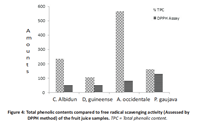
Results: The samples contained vitamin C in the range of 123-182 mg/100 g of fruit pulp. Psidium gaujava samples showed the highest free radical scavenging activity while Dialum guineense had the strongest ferric reducing power. Total phenolic compounds were highest in the juice of Anarcadium occidentale (566 mg GAE/100 g) and lowest in Dialum guineense (106 mg GAE/100 g). Tannins, reducing sugar, carbohydrates, steroids, glycosides, proteins and saponins were detected in the samples in varying degrees.
Conclusion: The juice of the fruit samples contained high amounts of vitamin C and exhibited good antioxidant activity. They can thus be used for prevention of free radical mediated diseases
Downloads
References
1. Sies H (1997). Oxidative Stress: Oxidants and antioxidants. Experimental Physiology 82(2): 291–295.
2. He J, Nowson CA, Lucas M and MacGregor GA (2007). Increased consumption of fruits and vegetables is related to a reduced risk of coronary heart disease: Meta-analysis of cohort studies. Journal of Human Hypertension 21(9): 717–728.
3. Maria do Socorro MR, Ricardo EA, de Brito ES, Perez-Jimenez J, Saura-Calixto F and Mancini-Filho J (2010). Bioactive compounds and antioxidant capacities of 18 non-traditional tropical fruits in Brazil. Food Chemistry 121: 996–1002.
4. Eiserich JP, van der Vliet A, Handelman GJ, Halliwell B and Cross CE (1995). Dietary antioxidants and cigarette smoke-induced biomolecular damage: a complex interaction. American Journal of Clinical Nutrition 62(6): 1490S–1500S.
5. Narayana KR, Reddy MS, Chaluvadi MR and Krishna DR (1998). Bioflavonoids classification, pharmacological, biochemical effects and therapeutic potential. Indian Journal of Pharmacology 33(1): 2–16.
6. Middleton EJ (2001). Effect of plant flavonoids on immune and inflammatory cell function. Advances in Experimental Medicine and Biology 439: 175–182.
7. Liuqing Y, Ying G, Ting Z, Jiangli Z, Fang L, Bingtao Z and Xiangyang W (2012). Antioxidant capacity of extracts from calyx fruits of roselle (Hibiscus sabdariffa L.). African Journal of Biotechnology 11(17): 4063–4068.
8. Willett WC and Stampfer MJ (2013). Current evidence on healthy eating. Annual Review of Public Health 34: 77–95.
9. Ray-Yu Y, Meei-Shyuan L, Wahlqvist M, Robert H and Keatinge JD (2015). Global trends in the promotion of fruit and vegetable consumption for better nutrition and health. Journal of Food Nutrition 2(2): 010–014.
10. Laurent GH, Toussaint OL, François GH, Lisette ES and Brice S (2012). Ethno-botanical study of the African star apple (Chrysophyllum albidum G. Don) in Southern Benin (West Africa). Journal of Ethnobiology and Ethnomedicine 8: 40–46.
11. Adepoju OT and Adeniji PO (2012). Nutrient composition and micronutrient potential of three wildly grown varieties of African star apple (Chrysophyllum albidum) from Nigeria. African Journal of Food Sciences 6(12): 344–351.
12. Rune B, Carlsen MH, Lene FA and Jacobs DR (2006). Health benefits of nuts: potential role of antioxidants. British Journal of Nutrition 96(S2): S52–S60.
13. Padayatty SJ, Katz A, Wang Y, Eck P, Kwon O, Lee JH, Chen S, Corpe C, Dutta A, Dutta SK and Levine M (2003). Vitamin C as an antioxidant: evaluation of its role in disease prevention. Journal of American College of Nutrition 22(1): 18–35.
14. Shibata K, Fukuwatari T, Imai E, Hayakawa T, Watanabe F, Takimoto H, Watanabe T and Umegaki K (2012). Dietary Reference Intakes for Japanese 2010: Water-Soluble Vitamins. Journal of Nutritional Science and Vitaminology 59: S67–S82.
15. Kokate CK (2001). Pharmacognosy. 16th Edition, Nirali Prakashan, Mumbai, India.
16. Pak SC and Simon ML (2004). A method for routine measurements of total sugar and starch content of woody plant tissue. Tree Physiology 24: 1129–1136.
17. Shafqat U, Arshad H, Javid AK and Asad Ullah (2012). A simple and rapid HPLC method for analysis of vitamin C in local packed juices of Pakistan. Middle-East Journal of Scientific Research 12(8): 1085–1091.
18. Sánchez-Rangel JC, Jorge BJ, Basilio H, Cisneros-Zevallos L and Jacobo-Velazquez DA (2013). The Folin-Ciocalteu assay revisited: improvement of its specificity for total phenolic content determination. Analytical Methods 5: 5990–5999.
19. Mudasir AS (2014). Phytochemical investigation and uses of some medicinal plants of Kashmir Himalaya - A review. International Journal of Biology, Pharmacy and Allied Sciences 3(3): 462–489.
20. Daramola B (2013). Assessment of some aspects of phytonutrients of cashew apple juice of domestic origin in Nigeria. African Journal of Food Science 7(6): 107–112.
21. Ravindran RD, Vashist P, Gupta SK, Young IS, Maraini G, Camparini M, Jayanthi R, John N, Fitzpatrick KE, Chakravarthy U, Ravilla TD and Fletcher AE (2011). Prevalence and risk factors for vitamin C deficiency in North and South India: a two-centre population based study in people aged 60 years and over. PLoS ONE 6(12): 1–8.
22. Contreras-Calderón J, Calderón-Jaimes L, Guerra-Hernández E and García-Villanova B (2011). Antioxidant capacity, phenolics content and vitamin C in pulp, peel and seed from 24 exotic fruits from Colombia. Food Research International 44: 2047–2053.
23. Sroka Z and Cisowski W (2003). Hydrogen peroxide scavenging, antioxidant and anti-radical activity of some phenolic acids. Food and Chemical Toxicology 41(6): 753–758.
24. Cho E, Seddon JM, Rosner B, Willett WC and Hankinson SE (2004). Prospective study of intake of fruits, vegetables, vitamins, and carotenoids and risk of age-related maculopathy. Archives of Ophthalmology 122(6): 883–892.
Downloads
Published
Issue
Section
License
Copyright (c) 2026 West African Journal of Pharmacy

This work is licensed under a Creative Commons Attribution-NonCommercial-NoDerivatives 4.0 International License.