Exploring the secondary metabolites and antioxidant capacities of methanol extract of Peperomia pellucida (L.) Kunth Leaves
Exploration des métabolites secondaires et des propriétés antioxydantes de l'extrait méthanolique des feuilles de Peperomia pellucida (L.) Kunth
DOI:
https://doi.org/10.82351/wajp.vol37no1.452Keywords:
phytochemicals, Secondary Metabolites, antioxidant capacity, Peperomia pellucida, composés phytochimiques, métabolites secondaires, capacité antioxydanteAbstract
Background: Medicinal plants remain vital in the development of natural therapeutic agents due to their rich phytochemical composition. Peperomia pellucida (L.) Kunth, a member of the Piperaceae family, is traditionally used to treat inflammation, fever, and oxidative stress-related ailments.
Objective: This study evaluated the phytochemical constituents and in vitro antioxidant activities of the methanol extract of P. pellucida leaves collected from Sagamu, Ogun State, Nigeria.
Method: The leaves were air-dried, pulverized, and extracted using 80% methanol. Standard qualitative and quantitative phytochemical analyses were performed to determine the presence of secondary metabolites. Antioxidant activities were assessed using Total Antioxidant Capacity (TAC), Ferric Reducing Antioxidant Power (FRAP), Total Phenolic Content (TPC), and 2,2-Diphenyl-1-picrylhydrazyl (DPPH) radical scavenging assays.
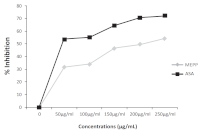
Results: Phytochemical screening revealed the presence of alkaloids (9.65 ± 0.004 mg/g), terpenoids (1.65 ± 0.001 mg/g), tannins (0.97 ± 0.001 mg/g), saponins (0.70 ± 0.003 mg/g), flavonoids (0.01 ± 0.145 mg/g), and phenols (0.64 ± 0.001 mg/g). The methanol extract demonstrated notable antioxidant activity, with mean TAC (1.40 ± 0.09 mg AAE/g), FRAP (4.08 ± 0.52 mg AAE/g), and TPC (1.62 ± 0.12 mg GAE/g). The DPPH assay showed a concentration-dependent free radical scavenging effect, yielding an IC50 value of 205.38 µg/mL compared to 46.5 µg/mL for ascorbic acid.
Conclusion: The findings indicate that Peperomia pellucida demonstrate measurable antioxidant potential, possibly due to its content phenolic, flavonoid, and alkaloid. This supports its traditional medicinal use and suggests its potential application as a natural antioxidant source in pharmaceutical and nutraceutical formulations.
Résumé
Contexte: Les plantes médicinales restent essentielles au développement d'agents thérapeutiques naturels en raison de leur riche composition phytochimique. Peperomia pellucida (L.) Kunth, membre de la famille des Pipéracées , est traditionnellement utilisée pour traiter l'inflammation, la fièvre et les affections liées au stress oxydatif.
Objectif: Cette étude a évalué les composants phytochimiques et les activités antioxydantes in vitro de l'extrait méthanolique de feuilles de P. pellucida récoltées à Sagamu, dans l'État d'Ogun, au Nigéria.
Méthode: Les feuilles ont été séchées à l'air libre, pulvérisées, puis extraites à l'aide de méthanol à 80 %. Des analyses phytochimiques qualitatives et quantitatives standard ont été réalisées afin de déterminer la présence de métabolites secondaires. Les activités antioxydantes ont été évaluées à l'aide des tests suivants : la capacité antioxydante totale (CAT), le pouvoir antioxydant réducteur du fer (FRAP), la teneur totale en composés phénoliques (TCP) et le test de piégeage du radical 2,2-diphényl-1-picrylhydrazyle (DPPH).
Résultats: Le criblage phytochimique a révélé la présence d'alcaloïdes (9.65 ± 0.004 mg/g), de terpénoïdes (1.65 ± 0.001 mg/g), de tanins (0.97 ± 0.001 mg/g), de saponines (0.70 ± 0.003 mg/g), de flavonoïdes (0.01 ± 0.145 mg/g) et de phénols (0.64 ± 0.001 mg/g). L'extrait méthanolique a démontré une activité antioxydante notable, avec une capacité antioxydante totale (CAT) moyenne de 1.40 ± 0.09 mg EAA/g, un FRAP de 4.08 ± 0.52 mg EAA/g et une teneur en composés phénoliques totaux (CPT) de 1.62 ± 0.12 mg EAG/g. Le test DPPH a montré un effet de piégeage des radicaux libres dépendant de la concentration, donnant une valeur IC50 de 205.38 µg/mL par rapport à 46.5 µg/mL pour l'acide ascorbique.
Conclusion: Les résultats indiquent que Peperomia pellucida possède un potentiel antioxydant mesurable, probablement dû à sa teneur en composés phénoliques, flavonoïdes et alcaloïdes. Ces données soutiennent son usage en médecine traditionnelle et suggèrent son application potentielle en tant que source naturelle d'antioxydants dans les formulations pharmaceutiques et nutraceutiques.
Downloads
References
1. Adebayo OL, Ogunlaja OO, Ojo MA (2022). Medicinal plants as natural antioxidants: Mechanisms and health implications. Journal of
Pharmacognosy and Phytotherapy 14(3):45-57. doi: 10.5897/JPP2022.0667.
2. Rahman MM, Hasan MN, Islam MT (2021). Reactive oxygen species and antioxidant defense in health and disease: Emerging perspectives.
Frontiers in Pharmacology 12:812409. doi: 10.3389/fphar.2021.812409.
3. Ngoka V, Mavoungou E, Mabika F, Ondo J (2023). Phytochemical screening and antioxidant properties of selected medicinal plants from Central Africa. Journal of Medicinal Plants Research 17(5):145-155.
4. Tuan CT, Men TT (2024). Peperomia pellucida's ingredients, antioxidant properties, and safe usage as food and herbal medicine. Journal of
Microbiology and Biotechnology 34(11):2321-2330. doi: 10.4014/jmb.2406.06025.
5. Knezevic E, Marolt S, Šuštar V (2025). Evaluation of spectrophotometric methods for assessing antioxidant potential in plant food samples: A
critical approach. Applied Sciences 15(11):5925. doi: 10.3390/app15115925.
6. Ahmad I, Hikmawan BD, Sulistyarini R, Mun'im A (2023). Peperomia pellucida (L.) Kunth herbs: A comprehensive review on phytochemical,
pharmacological, extraction engineering development, and economic perspectives. Journal of Applied Pharmaceutical Science 13(1):1-9. doi:
10.7324/JAPS.2023.130201.
7. Eze NC, Adamu A, Okafor J (2024). Phytochemical analysis and antioxidant potential of selected Nigerian medicinal plants. Plants 13(2):380-389. doi: 10.3390/plants13020380.
8. Benjamaa R, El Mostafa K, Zaki A (2024). Comparative evaluation of total antioxidant capacity assays: Methodological considerations and
applications in medicinal plants. Antioxidants 13(4):755-768. doi: 10.3390/antiox13040755.
9. Güçlü-Gündüz i (2023). DPPH radical scavenging assay: Principles, limitations, and applications in antioxidant research. Processes 11(8):2284. doi: 10.3390/pr11082284.
10. Pérez-Jiménez J, Saura-Calixto F, Mesías M (2023). Advances in understanding the Folin-Ciocalteu assay for total phenolics determination:
Mechanisms, interferences, and improvements. Food Chemistry 412:135563. doi: 10.1016/j.foodchem.2023.135563.
11. Men TT, Tuan CT (2022). Antioxidant and in vitro antidiabetic activities of Peperomia pellucida (L.) Kunth extract. Vietnam Journal of Science and Technology 60(4):477-486.
12. De Silva BCJ, Hossain S, Wimalasena SHMP, Pathirana HNKS, Heo GJ (2017). Antimicrobial effects of clove oil against pathogenic bacteria isolated from aquatic animals. Iranian Journal of Veterinary Research 18(2):128-133.
13. Phatak RS, Hendre AS (2014). Total antioxidant capacity (TAC) of fresh leaves of Kalanchoe pinnata. Journal of Pharmacognosy and Phytochemistry 2(5):32-35.
14. Ebrahimzadeh MA, Pourmorad F, Bekhradnia AR (2008). Iron chelating activity, phenol and flavonoid content of some medicinal plants from Iran. African Journal of Biotechnology 7(18):3188-3192.
15. Trease GE, Evans WC (2002). Textbook of Pharmacognosy (15th ed.). London: Saunders Publishers. pp.229-393.
16. Amarawiez R, Traszynska A, Pegg RG (2008). Antioxidative and radical scavenging effects of phenolics from Vicia sativum. Fitoterapia 79(8):121- 122.
17. Deguchi Y, Miyazaki K (2010). Anti-hyperglycemic and anti-hyperlipidemic effects of guava. Phytopharmacology 11:326.
Published
Issue
Section
License
Copyright (c) 2026 West African Journal of Pharmacy

This work is licensed under a Creative Commons Attribution-NonCommercial-NoDerivatives 4.0 International License.