

Ziziphus abyssinica hydro-ethanolic root bark extract attenuates acute inflammation possibly through membrane stabilization and inhibition of protein denaturation and neutrophil degranulation
Article Sidebar
Abstract Views | PDF/EPUB Downloads
293
/ 159
Main Article Content
Abstract
Background: Despite the widespread use of Ziziphus abyssinica (ZAE) roots and claims of its efficacy against diverse inflammatory conditions in traditional medicine, there is paucity of information on the scientific basis for its folkloric use.
Objectives: The current study evaluated the anti-inflammatory property of the root bark extract of ZAE and its possible mechanism(s) of action in in vivo and in vitro experimental models.
Methods: Anti-inflammatory activity of ZAE was assessed in vitro using heat and hypotonic solution – induced haemolysis as well as egg albumin (EA) and bovine serum albumin (BSA) denaturation assays. Carrageenan and formalin-induced paw oedema and carrageenan-induced peritonitis in rats were used to evaluate the anti-inflammatory property of the extract in vivo.
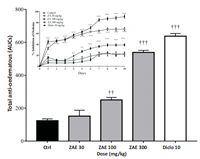
Results: ZAE (100, 300 and 1000 µg/mL) significantly inhibited heat and hypotonic solution-induced haemolysis as well as EA and BSA-induced denaturation. ZAE (300 mg/kg, p.o.) similar to diclofenac (10 mg/kg,p.o.), significantly (P<0.05) reduced paw oedema by 40.77±6.82 and 54.81 ± 3.74% respectively in carrageenan-induced paw oedema test. The percentage inhibitions produced by ZAE (30, 100 and 300 mg/kg,p.o.) were 3.31±22.12, 49.89±2.98 and 76.98±0.50 % respectively compared to 80.51±0.53 % produced by diclofenac (10 mg/kg, p.o.) in the formalin-induced paw oedema test. Massive recruitment of leukocytes (mainly neutrophils) into the peritoneal cavity of the rats by carrageenan was significantly (P<0.01) reduced by ZAE (30, 100 and 300 mg/kg p.o.) and dexamethasone (5 mg/kg, p.o.).
Conclusions: The inhibitory effect of ZAE against acute inflammation in this study provides scientific basis for its use in folk medicine and reveals its potential as a source of novel anti-inflammatory agent.
Downloads
Article Details
Issue
Section

This work is licensed under a Creative Commons Attribution-NonCommercial-NoDerivatives 4.0 International License.
How to Cite
Share
References
1. Ricciotti E and FitzGerald GA (2011). Prostaglandins and inflammation. Arteriosclerosis, Thrombosis, and Vascular Biology 31(5): 986-1000.
2. Vodovotz Y, Csete M, Bartels J, Chang S and An G (2008). Translational systems biology of inflammation. PLOS Computational Biology 4(4): e1000014.
3. Kamble AA, Khan ND, Khan ZH, Mular SM and Sohai S (2017). In vitro anti-arthritic effect of Vitex negundo and Punica granatum. Research Journal of Pharmaceutical Science 6(2): 5-7.
4. Begum VH and Sadique J (1988). Long term effect of herbal drug Withania somnifera on adjuvant induced arthritis in rats. Indian Journal of Experimental Biology 26(11): 877-882.
5. Rajendran R and Krishnakumar E (2010). Anti-arthritic activity of Premna serratifolia Linn. wood against adjuvant induced arthritis. Avicenna Journal of Medical Biotechnology 2(2): 101-106.
6. Cronan TA, Kaplan RM, Posner L, Blumberg E and Kozin F (1989). Prevalence of the use of unconventional remedies for arthritis in a metropolitan community. Arthritis & Rheumatology 32(12): 1604-1607.
7. Singh S, Nair V and Gupta Y (2011). Antiarthritic activity of Majoon Suranjan (a polyherbal Unani formulation) in rat. The Indian Journal of Medical Research 134(3): 384-388.
8. Agrawal S and Paridhavi M (2007). Herbal Drug Technology. Hyderabad: Universities Press Private Limited.
9. Kaleem WA, Muhammad N, Khan H and Rauf A (2014). Pharmacological and phytochemical studies of Genus Zizyphus. Middle-East Journal of Scientific Research 21: 1243-1263.
10. Orwa C, Mutua A, Kindt R, Jamnadass R and Simons A (2009). Agroforestree database: a tree reference and selection guide version 4.0. http://www.worldagroforestry.org/af/treedb/ [Accessed: 12 September, 2017].
11. Burkill HM (1985). The Useful Plants of West Tropical Africa. Vol. 4. Kew, Royal Botanic Gardens. http://plants.jstor.org/stable/10.5555/al.ap.upwta.4_778 [Accessed: 17 September, 2017].
12. Nyaberi MO, Onyango CA, Mathooko FM, Maina JM, Makobe M and Mwaura F (2010). Evaluation of phytochemical, antioxidant and antibacterial activity of edible fruit extracts of Ziziphus abyssinica A. Rich. Journal of Animal & Plant Sciences 6(2): 623-629.
13. Ugwah MO, Etuk EU, Bello SO, Aliero AA and Ugwah-Oguejiofor CJ (2013). Comparative studies of anti-ulcerogenic activities of three Nigerian medicinal plants: A preliminary evaluation. Journal of Medicinal Plants Research 7(9): 490-495.
14. Boakye-Gyasi E, Henneh IT, Abotsi WKM, Ameyaw EO and Woode E (2017). Hydro-ethanolic leaf extract of Ziziphus abyssinica Hochst Ex A. Rich (Rhamnaceae) exhibits anti-nociceptive effects in murine models. BMC Complementary and Alternative Medicine 17(1): 231-243.
15. Gundidza M and Sibanda M (1991). Antimicrobial activities of Ziziphus abyssinica and Berchemia discolor. Central African Journal of Medicine 37(3): 80-83.
16. Wagate CG, Mbaria JM, Gakuya DW, Nanyingi MO, Kareru PG, Njuguna A, et al. (2010). Screening of some Kenyan medicinal plants for antibacterial activity. Phytotherapy Research 24(1): 150-153.
17. Muthaura CN, Keriko JM, Mutai C, Yenesew A, Gathirwa JW, Irungu BN, et al. (2015). Antiplasmodial potential of traditional phytotherapy of some remedies used in treatment of malaria in Meru-Tharaka Nithi County of Kenya. Journal of Ethnopharmacology 175(4): 315-323.
18. Boakye-Gyasi E, Henneh IT, Abotsi WKM, Ameyaw EO and Woode E (2017). Possible mechanisms involved in the anti-nociceptive effects of hydro-ethanolic leaf extract of Ziziphus abyssinica. Pharmaceutical Biology 55(1): 1962-1971.
19. Ugwah-Oguejiofor JC, Alkali IY, Ugwah MO and Abubakar K (2013). Antidiarrhoeal potential of the aqueous root extract of Ziziphus abyssinica A. Rich. Scholars Academic Journal of Pharmacy 2: 419-423.
20. Tiwari P, Kumar B, Kaur M, Kaur G and Kaur H (2011). Phytochemical screening and extraction: a review. Internationale Pharmaceutica Sciencia 1(1): 98-106.
21. Garber JC, Barbee RW, Bielitzki JT, Clayton L, Donovan J, Hendriksen CM, et al. (2011). Guide for the Care and Use of Laboratory Animals. Vol. 8. Washington DC: The National Academic Press.
22. Leelaprakash G and Dass SM (2011). In vitro anti-inflammatory activity of methanol extract of Enicostemma axillare. International Journal of Drug Development Research 3: 189-196.
23. Laboni FR, Afsari F, Howlader SI, Labu ZK and Azima SJ (2015). Thrombolytic and membrane stabilizing activities of ethanolic extract of local medicinal plant Murraya paniculata (Family: Rutaceae). Journal of Pharmacognosy and Phytochemistry 4(2): 17-20.
24. Ullah HA, Zaman S, Juhara F, Akter L, Tareq SM, Masum EH, et al. (2014). Evaluation of antinociceptive, in vivo and in vitro anti-inflammatory activity of ethanolic extract of Curcuma zedoaria rhizome. BMC Complementary and Alternative Medicine 14(1): 346.
25. Neha Mohan P, Suganthi V and Gowri S (2013). Evaluation of anti-inflammatory activity in ethanolic extract of Coriandrum sativum L. using carrageenan induced paw oedema in albino rats. Der Pharma Chemica 5(2): 139-143.
26. Choudhary M, Kumar V, Gupta P and Singh S (2014). Investigation of antiarthritic potential of Plumeria alba L. leaves in acute and chronic models of arthritis. BioMed Research International 2014: 1-12.
27. Nonato FR, Santana DG, de Melo FM, dos Santos GG, Brustolim D, Camargo EA et al. (2012). Anti-inflammatory properties of rose oxide. International Immunopharmacology 14(4): 779-784.
28. Chandra S, Chatterjee P, Dey P and Bhattacharya S (2012). Evaluation of in vitro anti-inflammatory activity of coffee against the denaturation of protein. Asian Pacific Journal of Tropical Biomedicine 2(1): S178-S180.
29. Omale J and Okafor PN (2008). Comparative antioxidant capacity, membrane stabilization, polyphenol composition and cytotoxicity of the leaf and stem of Cissus multistriata. African Journal of Biotechnology 7(17): 3129-3133.
30. Augusto O, Kunze KL and de Montellano PO (1982). N-Phenylprotoporphyrin IX formation in the hemoglobin-phenylhydrazine reaction. Evidence for a protein-stabilized iron-phenyl intermediate. Journal of Biological Chemistry 257(11): 6231-6241.
31. Ferrali M, Signorini C, Ciccoli L and Comporti M (1992). Iron release and membrane damage in erythrocytes exposed to oxidizing agents, phenylhydrazine, divicine and isouramil. Biochemical Journal 285(1): 295-301.
32. Rahman H, Eswaraiah MC and Dutta A (2015). In-vitro anti-inflammatory and anti-arthritic activity of Oryza sativa var. Joha rice (an aromatic indigenous rice of Assam). American-Eurasian Journal of Agriculture and Environmental Science 15: 115-121.
33. Marliyah M (2015). In vitro anti-inflammatory activity of seed extract of Zea mays (L.). Global Journal of Biosciences 4(5): 2168-2173.
34. Opie EL (1962). On the relation of necrosis and inflammation to denaturation of proteins. Journal of Experimental Medicine 115: 597-608.
35. Duganath N, Kumar SR, Kumanan R and Jayaveera KN (2010). Evaluation of anti-denaturation property and anti-oxidant activity of traditionally used medicinal plants. International Journal of Pharmacy and Biosciences 1(2): 110-117.
36. Krishnaraju AV, Rao CV, Rao TV, Reddy K and Trimurtulu G (2009). In vitro and in vivo antioxidant activity of Aphanamixis polystachya bark. American Journal of Infectious Diseases 5(2): 60-67.
37. Okpuzor J and Oloyede AM (2009). Anti-inflammatory, antipyretic and anti-diarrhoeal properties of an antihaemorrhoid tri-herbal pill. Nature Science 7: 89-94.
38. Morris CJ (2003). Carrageenan-induced paw edema in the rat and mouse. Inflammation Protocols: 115-121.
39. Posadas I, Bucci M, Roviezzo F, Rossi A, Parente L, Sautebin L and Cirino G (2004). Carrageenan-induced mouse paw oedema is biphasic, age-weight dependent and displays differential nitric oxide cyclooxygenase-2 expression. British Journal of Pharmacology 142(2): 331-338.
40. Fulgenzi A, Dell'Antonio G, Foglieni C, Dal Cin E, Ticozzi P, Franzone JS, et al. (2005). Inhibition of chemokine expression in rat inflamed paws by systemic use of the antihyperalgesic oxidized ATP. BMC Immunology 6(1): 8.
41. Loram L, Fuller A, Fick L, Cartmell T, Poole S and Mitchell D (2007). Cytokine profiles during carrageenan-induced inflammatory hyperalgesia in rat muscle and hind paw. Journal of Pain 8(2): 127-136.
42. Nair V, Singh S and Gupta Y (2011). Evaluation of the disease modifying activity of Colchicum luteum Baker in experimental arthritis. Journal of Ethnopharmacology 133(2): 303-307.
43. Brito TV, Prudêncio RD, Sales AB, Vieira Júnior FD, Candeira SJ, Franco ÁX, Aragão KS, Ribeiro RD, de Souza P, Loiola MH and Chaves LD (2013). Anti-inflammatory effect of a sulphated polysaccharide fraction extracted from the red algae Hypnea musciformis via the suppression of neutrophil migration by the nitric oxide signalling pathway. Journal of Pharmacy and Pharmacology 65(5): 724-733.
44. Adedapo AA, Sofidiya MO, Maphosa V, Moyo B, Masika PJ, et al. (2005). Anti-inflammatory and analgesic activities of the aqueous extract of Cussonia paniculata stem bark. Records of Natural Products 2(2): 46-53.
45. Guzik T, Korbut R and Adamek-Guzik T (2003). Nitric oxide and superoxide in inflammation. Journal of Physiology and Pharmacology 54(4): 469-487.
46. Kumar S and Pandey AK (2013). Chemistry and biological activities of flavonoids: an overview. Scientific World Journal 2013: 1-16.
47. Yauan G, Wahlqvist M, He G, Yang M and Li D (2006). Natural products and anti-inflammatory activity. Asia Pacific Journal of Clinical Nutrition 15(2): 143-152.
48. Chao J, Lu TC, Liao JW, Huang TH, Lee MS, Cheng HY, et al. (2009). Analgesic and anti-inflammatory activities of ethanol root extract of Mahonia oiwakensis in mice. Journal of Ethnopharmacology 125(2): 297-303.
49. Chen Y-C, Liu Y-L, Li F-Y, Chang C-L, Wang S-Y, Lee K-Y, et al. (2011). Antcin A, a steroid-like compound from Antrodia camphorata, exerts anti-inflammatory effect via mimicking glucocorticoids. Acta Pharmacologica Sinica 32: 904-911.