

Protective effects of Baicalein against haloperidol and high fructose-induced behavioural changes in mice via stimulation of antioxidant pathways Effets protecteurs de la baicaléine contre les changements comportementaux induits par l'halopéridol et un taux élevé de fructose chez les souris via la stimulation des voies antioxydantes
Article Sidebar
Abstract Views | PDF/EPUB Downloads
555
/ 162
/ 94
Main Article Content
Abstract
ENGLISH
Background: Previous research has indicated that neurodegenerative disorders are connected to metabolic alterations, which triggers their progression or onset. Haloperidol and high-fructose diet have also been found to induce neurobehavioural abnormalities via induction of oxidative stress. Baicalein has been shown to exhibit neuroprotective effect.
Objective: This study was conducted to investigate the modulatory effects of Baicalein against high-fructose and haloperidol-induced behavioural alterations, and antioxidant levels in mice.
Methods: Male Swiss mice (20-25 g) were randomly distributed into 7 groups (n = 6) and fed with high fructose diet (HFD) ad libitum for two weeks. Baicalein (BAC) was given at low (10 mg/kg), moderate (50 mg/kg) and high doses (100 mg/kg). The treatment schedule were as follows: Group 1: control (Normal Saline: NS, 10 mL/kg i.p.); Group 2: High Fructose Diet (HFD, 20 % p.o.); Group 3: Haloperidol (HAL, 2 mg/kg i.p.); Group 4: Baicalein (BAC2, 50 mg/kg p.o.); Group 5: HFD (20 % p.o.) + HAL (2 mg/kg i.p.) + BAC (10 mg/kg p.o.); Group 6: HFD (20 % p.o.) + HAL (2 mg/kg i.p.) + BAC (50 mg/kg p.o.); Group 7: HFD (20 % p.o.) + HAL (2 mg/kg i.p.) + BAC (100 mg/kg p.o.) for 14 days. Behavioural parameters were observed and recorded. Blood glucose levels were taken and recorded on days 1, 8 and 14. Afterwards, the animals were sacrificed and the brain was extracted for further assays.
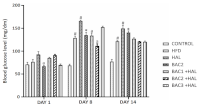
Results: Baicalein improved locomotion, mitigated cognitive deficits and improved head dips in the open field, Ymaze and hole board tests respectively. Also, Baicalein treatment reduced the blood glucose levels increased by haloperidol and HFD exposure, as well as, increasing the levels of antioxidants glutathione, catalase and superoxide dismutase that was reduced by HFD and haloperidol.
Conclusion: Findings suggest that Baicalein possess mitigatory effects on haloperidol and high fructose-induced alterations in mice.
FRENCH
Contexte: Des recherches antérieures ont indiqué que les troubles neurodégénératifs sont liés à altérations métaboliques, ce qui déclenche leur progression ou leur apparition. Il a également été démontré que l'halopéridol et un régime riche en fructose induisent des anomalies neurocomportementales par l'induction d'un stress oxydatif. La baicaléine a démontré des effets neuroprotecteurs.
Objectif: Cette étude a été menée afin d'étudier les effets modulateurs de la baïcaléine sur les altérations comportementales induites par un régime riche en fructose et l'halopéridol, ainsi que les niveaux d'antioxydants chez les souris.
Méthodes: Des souris mâles Swiss (20-25 g) ont été réparties aléatoirement en 7 groupes (n = 6) et nourries à volonté avec un régime riche en fructose (HFD) pendant deux semaines. La baïcaléine (BAC) a été administrée à des doses faibles (10 mg/kg), modérées (50 mg/kg) et élevées (100 mg/kg). Le programme de traitement était le suivant : Groupe 1 : témoin (solution saline normale : NS, 10 ml/kg). i.p.); Groupe 2 : Régime riche en fructose (HFD, 20 % po) ; Groupe 3 : halopéridol (HAL, 2 mg/kg i.p. ); Groupe 4 : baïcaléine (BAC2, 50 mg/kg p.o.) ; Groupe 5 : HFD (20 % p.o.) + HAL (2 mg/kg i.p. ) + BAC (10 mg/kg po) ; Groupe 6 : HFD (20 % p.o.) + HAL (2 mg/kg i.p.) + BAC (50mg/kg p.o.) ; Groupe 7 : HFD (20 % p.o.) + HAL (2 mg/kg i.p.) + BAC (100 mg/kg po) pendant 14 jours. Les paramètres comportementaux ont été observés et enregistrés. Les taux de glycémie ont été mesurés et enregistrés les jours 1, 8 et 14. Ensuite, les animaux ont été sacrifiés et le cerveau a été extrait pour des analyses complémentaires.
Résultats: La baicaléine a amélioré la locomotion, atténué les déficits cognitifs et amélioré les plongeons de la tête lors des tests en champ libre, du labyrinthe en Y et de la planche perforée, respectivement. De plus, le traitement à la baicaléine a réduit les taux de glycémie, augmentés par l'halopéridol et l'exposition au HFD, ainsi que les taux d'antioxydants glutathion, catalase et superoxyde dismutase, diminués par le HFD et l'halopéridol.
Conclusion: Les résultats suggèrent que la baicaléine possède des effets atténuants sur les altérations induites par l'halopéridol et le fructose élevé chez la souris.
Downloads
Article Details
Issue
Section

This work is licensed under a Creative Commons Attribution-NonCommercial-NoDerivatives 4.0 International License.
How to Cite
Share
References
1. Vauzour D, Corona G, Spencer JPE (2010). Caffeic acid, tyrosol and p coumaric acid are potent inhibitors of 5-S-cysteinyl-dopamine induced
neurotoxicity. Archives of Biochemistry and Biophysics 501(1):106-111.
2. De Ryck M, Schallert T, Teitelbaum P (1980). Morphine versus haloperidol catalepsy in the rat: a behavioural analysis of postural support
mechanisms. Brain Research 201(1):143-172.
3. Waku I, Magalhaes MS, Alves CO, De Oliveira AR (2021). Haloperidol-induced catalepsy as an animal model for parkinsonism: A systematic review of experimental studies. European Journal of Neuroscience 53(11):3743-3767
4. Sanberg PR, Pevsner J, Coyle JT (1984). Parametric influences on catalepsy. Psychopharmacology 82(4):406-408.
5. Stanhope KL (2012). Role of fructose-containing sugars in the epidemics of obesity and metabolic syndrome. Annual Review of Medicine 63(1):329-343.
6. Catena C, Giacchetti G, Novello M (2003). Cellular mechanisms of insulin resistance in rats with fructose-induced hypertension. American Journal of Hypertension 16 (11):973- 978.
7. Lee DH, Lee JU, Kang DG (2001). Increased vascular endothelin-1 gene expression with unaltered nitric oxide synthase levels in fructose-induced hypertensive rats. Metabolism 50:74-78.
8. Sanchez-Lozada LG, Tapia E, Jimenez A (2007). Fructose-induced metabolic syndrome is associated with glomerular hypertension and renal
microvascular damage in rats. American Journal of Physiology - Renal Physiology 292:F423-F429
9. Cadonic C, Sabbir MG, Albensi BC (2016). Mechanisms of mitochondrial dysfunction in Alzheimer's disease. Molecular Neurobiology 53(9):6078-6090.
10. Muddapu VR, Dharshini SAP, Chakravarthy VS, Gromiha MM (2020). Neurodegenerative diseases - is metabolic deficiency the root cause? Frontiers in Neuroscience 14:213. doi: 10.3389/fnins.2020.00213
11. Dantzer R, O'Connor JC, Freund GG, Johnson RW, Kelley KW (2008). From inflammation to sickness and depression: when the immune system subjugates the brain. Nature Reviews Neuroscience 9(1):45-56.
12. Cheng R, Dhorajia V, Kim J, Kim Y (2022). Mitochondrial iron metabolism and neurodegenerative diseases. Neurotoxicology 88:88-101.
13. Butterfield DA, Halliwell B (2019). Oxidative stress, dysfunctional glucose metabolism and Alzheimer disease. Nature Reviews Neuroscience 20(3):148-160.