

Antioxidant and in vitro membrane stabilization activities of leaf extract of Gossypium barbadense L. (Malvaceae)
Article Sidebar
Abstract Views | PDF/EPUB Downloads
269
/ 97
Main Article Content
Abstract
Background: Gossypium barbadense L. (GB) is used in the treatment of various diseases such as convulsions, jaundice, gastrointestinal disorders, and rheumatism in African traditional medicine.
Objectives: This study aimed at evaluating the antioxidant and in vitro membrane stabilization activities of leaf extracts of GB.
Methods: Gossypium barbadense n-hexane (GBHE), dichloromethane (GBDC), ethyl acetate (GBET) and methanol (GBME) extracts were assayed for phytochemical constituents, DPPH free radicals cavenging activity, cytotoxicity using brine shrimp lethality assay as well as In vitro red blood cell membrane stabilization assay (MSA)
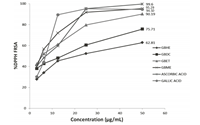
Results: Phytochemical screening of GB revealed the presence of cardiac glycosides, tannins, flavonoids, and steroids. The GBME had the highest phenolic (196.8 ± 3.72 mgGAE/g sample), flavonoid content (75.1 ± 1.97 mgRE/g sample) and DPPH scavenging activity (IC50 of 3.56±0.82 µg/mL). Also, GBHE and GBME showed the highest and lowest cytotoxicity, respectively. The GBET demonstrated significant MSA of 83.71% at 1mg/mL, while Indomethacin gave 68.30% protection.
Conclusion: The high contents of flavonoids and phenolics in Gossypium barbadense could be responsible for its antioxidant property and red blood cell membrane stabilization activity.
Downloads
Article Details
Issue
Section

This work is licensed under a Creative Commons Attribution-NonCommercial-NoDerivatives 4.0 International License.
How to Cite
Share
References
1. Essien EE, Aboaba SO and Ogunwande IA (2011). Constituents and antimicrobial properties of the leaf essential oil of Gossypium barbadense (Linn.). Journal of Medicinal Plants Research 5(5): 702-705.
2. Wu Z, Soliman KM, Zipf A, Saha S, Sharma GC and Jenkins JN (2005). Isolation and characterization of genes differentially expressed in fiber of Gossypium barbadense L. Journal of Cotton Science 9: 166-174.
3. Gbadamosi IT and Obogo SF (2013). Chemical constituents and in vitro antimicrobial activities of five botanicals used traditionally for the treatment of neonatal jaundice in Ibadan, Nigeria. Nature and Science 11(10): 130-135.
4. Salako OA and Awodele O (2012). Evaluation of the antimalarial activity of the aqueous leaf extract of Gossypium barbadense (Malvaceae) in mice. Drugs and Therapy Studies 2: e2.
5. Ikobi E, Igwilo CI, Awodele O and Azubuike C (2012). Antibacterial and wound healing properties of methanolic extract of dried fresh Gossypium barbadense leaves. Asian Journal of Biomedical and Pharmaceutical Sciences 2(13): 32-37.
6. Hasrat JA, Pieters L and Vlietinck AJ (2004). Medicinal plants in Suriname: hypotensive effect of Gossypium barbadense. Journal of Pharmacy and Pharmacology 56: 381-387.
7. Stipanovic RD, Lopez JD and Dowd MK (2006). Effect of racemic and (+)- and (-)-gossypol on the survival and development of Helicoverpa zea larvae. Journal of Chemical Ecology 32: 959-968.
8. Coyle T, Levante S, Shetler M and Winfield J (1994). In vitro and in vivo cytotoxicity of gossypol against central nervous system tumor cell lines. Journal of Neuro-Oncology 19: 25-35.
9. Todou G and Konsala S (2011). Gossypium barbadense L. [Internet] Fiche de PROTA4U. Brink M and Achigan-Dako EG (Eds.). PROTA (Plant Resources of Tropical Africa/Ressources végétales de l'Afrique tropicale), Wageningen, Pays Bas. http://www.prota4u.org/search.asp.
10. Trease GE and Evans WC (2002). Pharmacognosy. 15th Edition, Saunders Publishers, London. pp. 214-252.
11. Sofowora A (1993). Medicinal Plants and Medicine in Africa. Spectrum Books, Ibadan, Nigeria. pp. 120-123.
12. Rohman A, Riyanto S, Yuniarti N, Saputra WR, Utami R and Mulatsih W (2010). Antioxidant activity, total phenolic, and total flavonoid of extracts and fractions of red fruit (Pandanus conoideus Lam). International Food Research Journal 17: 97-106.
13. Sultana B, Anwar F and Ashraf M (2009). Effect of extraction solvent/technique on the antioxidant activity of selected medicinal plant extracts. Molecules 14: 2167-2180.
14. Kuete V, Azebaze AG, Mbaveng A, Ngunefo EL, Tshikalange ET, Chalard P and Nkengfack AE (2011). Antioxidant, antitumour and antimicrobial activities of the crude extract and compounds of the root bark of Allanblackia floribunda. Pharmaceutical Biology 49(1): 57-65.
15. Berber A, Zengin G, Aktumsek A, Sanda MA and Uysal T (2014). Antioxidant capacity and fatty acid composition of different parts of Adenocarpus complicatus (Fabaceae) from Turkey. Revista de Biologia Tropical 62(1): 337-346.
16. Ramachandran S, Vamsikrishna M, Gowthami KV, Heera B and Dhanaraju MD (2011). Assessment of cytotoxic activity of Agave cantula using brine shrimp (Artemia salina) lethality bioassay. Asian Journal of Scientific Research 4: 90-94.
17. Sadique J, Al-Rqobah NA, Bughaith MF and El-Gindy AR (1989). The bioactivity of certain medicinal plants on the stabilization of RBC membrane system. Fitoterapia 60: 525-532.
18. Nakamura Y, Watanabe S, Miyake N, Kohno H and Osawa T (2003). Dihydrochalcones: Evaluation as novel radical scavenging antioxidants. Journal of Agricultural and Food Chemistry 51: 3309-3312.
19. Othman A, Ismail A, Ghani AN and Adenan I (2007). Antioxidant capacity and phenolic content of cocoa beans. Food Chemistry 100: 1523-1530.
20. Cao G, Sofic E and Prior RL (1997). Antioxidant and prooxidant behavior of flavonoids: structure-activity relationships. Free Radical Biology and Medicine 22: 749-760.
21. Javanmardi J, Stushnoff C, Locke E and Vivanco JM (2003). Antioxidant activity and total phenolic content of Iranian Ocimum accessions. Food Chemistry 83: 547-550.
22. Li H, Hao Z, Wang X, Huang L and Li J (2009). Antioxidant activities of extracts and fractions from Lysimachia foenum-graecum Hance. Bioresource Technology 100: 970-974.
23. Kouassi K, N'guessan JD, Méité S, Yapi A, Yapi HF and Djaman AJ (2013). In vitro antioxidant activity and phenolic contents of the leaves of Olax subscorpioidea and Distemonanthus benthamianus. Research Journal of Pharmaceutical, Biological and Chemical Sciences 4(4): 1419-1430.
24. Maisuthisakul P, Suttajit M and Pongsawatmanit R (2007). Assessment of phenolic content and free radical scavenging capacity of some Thai indigenous plants. Food Chemistry 100: 1409-1418.
25. McLaughlin JL and Rogers L (1998). The use of biological assays to evaluate botanicals. Drug Information Journal 32: 513-524.
26. Ajaiyeoba EO, Abiodun OO, Falade MO, Ogbole NO, Ashidi JS, Happi CT and Akinboye DO (2006). In vitro cytotoxicity studies of 20 plants used in Nigerian antimalarial ethnomedicine. Phytomedicine 13: 295-298.
27. Rahul N, Divya S, Amit G, Mohit B and Patel H (2014). Anti-inflammatory activity of various fractions of methanolic extract of Punica granatum rind with its phytochemical evaluation. International Journal of Phytotherapy 4(3): 112-114.
28. Oyedapo OO, Akindele VR and Okunfolami OK (1997). Effects of extracts of Olax subscorpioides and Aspilia africana on bovine red blood cells. Phytotherapy Research 11: 305-306.
29. Saleem TK, Azeem AK, Dilip C, Sankar C, Prasanth NV and Duraisami R (2011). Anti-inflammatory activity of the leaf extracts of Gendarussa vulgaris Nees. Asian Pacific Journal of Tropical Biomedicine 1(2): 147-149.
30. Oyedapo OO, Akinpelu BA, Akinwunmi KF, Adeyinka MO and Sipeolu FO (2010). Red blood cell membrane stabilizing potentials of extracts of Lantana camara and its fractions. International Journal of Plant Physiology and Biochemistry 2(4): 46-51.
31. Oyedapo OO, Akinpelu BA and Orefuwa SO (2004). Anti-inflammatory effect of Theobroma cacao root extract. Journal of Tropical Medicinal Plants 5: 161-166.
32. Sabiu S, Ajani EO, Ajao AA, Sunmonu TO, Ibraheem AS, Ibrahim R, Mustapha H and Adekeye AO (2017). Biomembrane stabilization and antiulcerogenic properties of aqueous leaf extract of Gossypium barbadense L. (Malvaceae). Beni-Suef University Journal of Basic and Applied Sciences 6: 301-309.